
Type 5 Diabetes: Recognizing Malnutrition-Related Diabetes in Clinical Practice
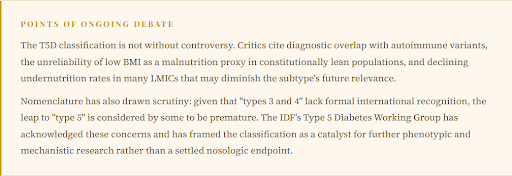
The IDF's April 2025 consensus formally recognized Type 5 Diabetes (T5D), a form of diabetes rooted in chronic malnutrition, nearly 7 decades after its initial clinical description. For endocrinologists and diabetologists practicing in or consulting on patients from low- and middle-income countries, this recognition demands clinical attention. Misclassification as T1D or T2D carries real therapeutic consequences.
Epidemiology and Global Burden
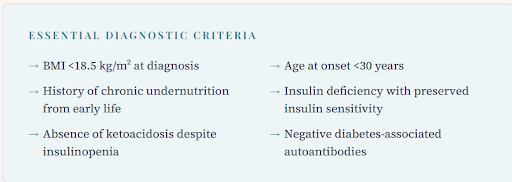
Type 5 diabetes primarily affects lean, young individuals, with a BMI below 18.5 kg/m², typically presenting before age 30 with a history of undernutrition beginning in utero and persisting through childhood. The condition is concentrated in rural sub-Saharan Africa, South Asia, and parts of Latin America and the Caribbean, where chronic nutritional deprivation remains endemic.
The epidemiologic signal is substantial. In rural LMIC settings, an estimated 40–50% of lean individuals presenting with insulin-dependent diabetes are negative for diabetes-associated autoantibodies — a critical distinguishing feature that sets T5D apart from classical type 1 disease.
Pathophysiology: The Malnourished Pancreas
The pathophysiologic framework centers on early-life nutritional deprivation — including protein and micronutrient deficiencies — that permanently reduces β-cell mass and function. The result is a "malnourished pancreas" phenotype characterized by concurrent endocrine and exocrine failure.
Importantly, this insulin deficiency occurs alongside preserved peripheral insulin sensitivity, a feature that distinguishes T5D from type 2 diabetes at the mechanistic level and has direct implications for pharmacologic management.
Diagnostic Framework
The IDF consensus established essential clinical criteria for T5D, paired with a structured tiered diagnostic approach designed to systematically exclude autoimmune and type 2 etiologies.
Tiered Diagnostic Approach
Clinical Assessment & Standard Glycemic Testing: Standard diabetes confirmation (FPG ≥126 mg/dL, 2-hr OGTT glucose ≥200 mg/dL, or HbA1c ≥6.5%) combined with thorough nutritional history and anthropometric assessment.
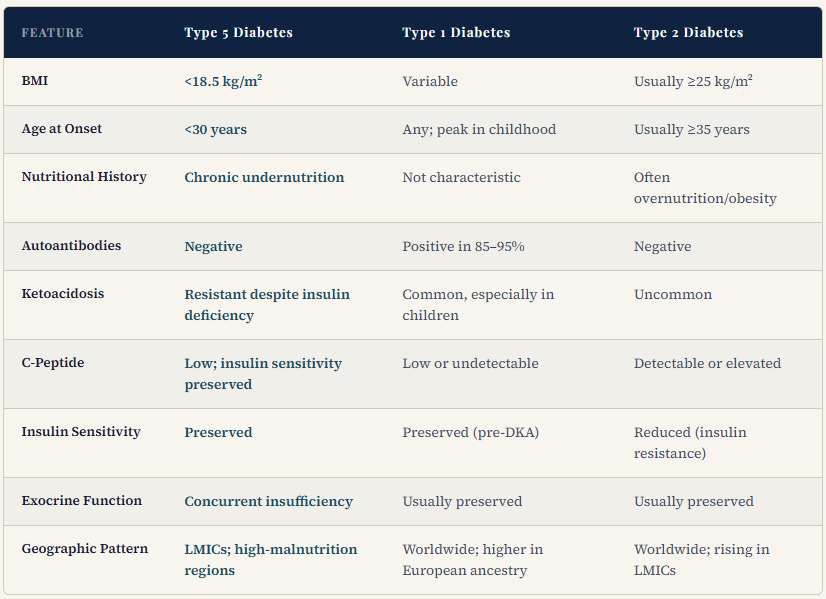
Autoimmune Exclusion: Panel testing for GAD65, IA-2/IA-2β, ZnT8, and insulin autoantibodies. T5D is uniformly autoantibody-negative; 85–95% of T1D patients carry at least one positive antibody at diagnosis. This tier is essential and non-negotiable before proceeding.
C-Peptide / β-Cell Function Assessment: Stimulated C-peptide (post-glucagon or mixed meal) remains the gold standard. T5D demonstrates low C-peptide concentrations — consistent with insulinopenia — but with intact peripheral insulin sensitivity, distinguishing it from both T1D (near-undetectable C-peptide) and T2D (detectable or elevated).
Pancreatic Imaging: CT, MRI/MRCP, or endoscopic ultrasound. Expected findings include reduced pancreatic volume and parenchymal atrophy without calcifications (distinguishing T5D from chronic pancreatitis).
Exocrine Pancreatic Function Testing: Fecal elastase-1 is the recommended first-line test; the secretin-cerulein test is the gold standard for detecting mild-to-moderate insufficiency. Confirmation of exocrine failure reinforces the "malnourished pancreas" phenotype central to T5D.
Differential at a Glance
Management Considerations
T5D management diverges from both T1D and T2D in important ways. Coordinated hormonal and enzyme replacement therapy is required alongside structured nutritional rehabilitation targeting protein and micronutrient deficits. Because patients are resistant to ketosis despite insulinopenia, the urgency of insulin initiation differs from classic T1D presentations.
Clinicians should maintain a high index of suspicion for malnutrition-related complications and micronutrient deficiencies — these are not incidental but integral to the pathophysiology.
Clinical Takeaway for Endocrinologists & Diabetologists
Any lean, young patient presenting with insulin-dependent diabetes — particularly those from regions with high malnutrition burden or with a personal history of early-life nutritional deprivation — should prompt consideration of T5D before defaulting to a T1D diagnosis.
The autoantibody panel and stimulated C-peptide remain the most clinically actionable discriminators at initial evaluation. Pancreatic imaging and exocrine testing should follow for confirmatory phenotyping. Misclassification as T1D or T2D is not merely academic — it translates directly to inappropriate treatment, unaddressed nutritional deficits, and missed exocrine disease.